
What this document is
The twelve-month launch sequence for five mutually reinforcing assets: a Veterans Support Site, CHDO readiness, CDFI partnerships, Community Land Trust legal design, and a Service Animal Referral Pilot.
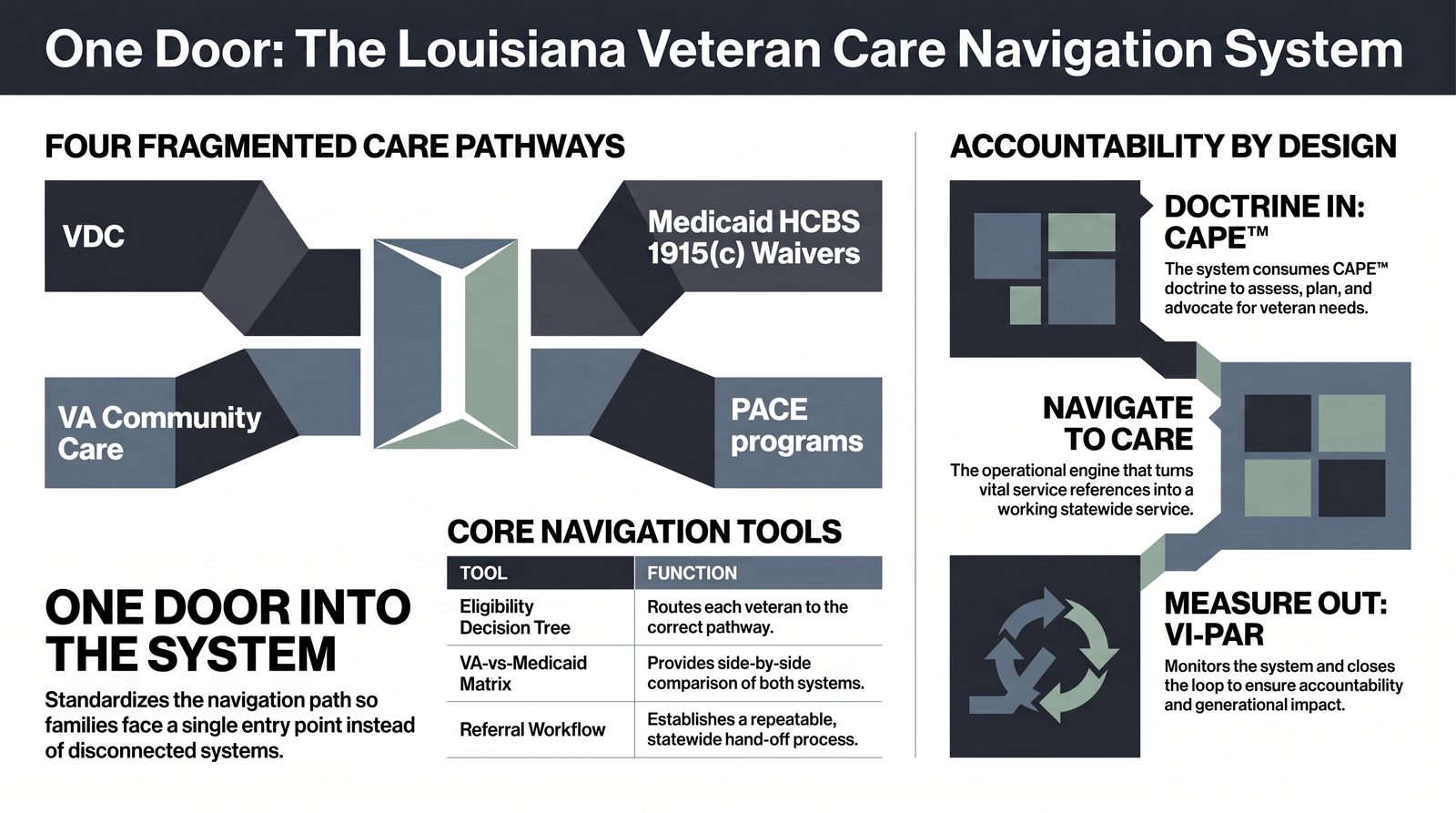
The problem it solves: veterans and caregivers face The problem it solves: five good ideas launched simultaneously produce five half-built things. This sequences them so each one is standing before the next begins.. The framework standardizes the path so families face one door, not many.
It is designed to become a Year one is deliberately a capacity-building year. It builds the compliance, partnership, intake and governance foundation that larger housing, capital and land initiatives will need in years two through five. and a repeatable reference for the navigation team, with VI-PAR™ monitoring closing the loop.
Five assets, one sequence
The Veterans Support Site is built first because everything else routes through it. Without a front door, the other four pillars have no way to reach a Veteran.
CHDO readiness runs second — a governance and documentation exercise, not a construction project. It opens HOME set-aside funds and operating support through Louisiana Housing Corporation.
CDFI partnerships come third, as referral relationships rather than a certification attempt. Community Land Trust legal design is fourth, because getting the ownership structure wrong is expensive to unwind.
The Service Animal Referral Pilot runs last and stays a referral pathway in year one — not a training facility.
Start with the front door
The Veterans Support Site coordinates intake, CAPE™ planning, claims-readiness document organisation, referral routing, follow-up and provider performance monitoring.
It uses the intake standard already defined elsewhere in this library. It does not build a second one.
One boundary governs everything it does: claims representation requires VA accreditation. The site provides intake, education, document readiness, referral coordination and warm handoff to accredited representatives, attorneys or claims agents — and nothing beyond that line.
What CHDO readiness actually buys
A Community Housing Development Organization designation makes LCDC eligible for HOME CHDO set-aside funds and, tied to CHDO projects, potential operating support.
Year one is a readiness assessment, not an application sprint: governance review, board composition, community representation, financial controls, housing development capacity, and a corrective action plan for whatever the review exposes.
Board composition and community representation are the usual failure points. They are also the slowest to fix, which is why this pillar starts in month two rather than month ten.
Capital without becoming a lender
The Consortium should not attempt its own CDFI certification in year one. It should become a referral partner to institutions that already hold one.
The work is identifying ten to fifteen regional CDFIs and mission lenders, holding five to eight introductory meetings, and executing two to four referral agreements.
Most Veterans reaching this pathway need credit repair before they need a loan product, so financial coaching referral is the first live service — not capital deployment.
Land, and why the structure matters
A Community Land Trust preserves affordability permanently by separating ownership of the land from ownership of the building.
Year one produces a structure options memo — programme of LCDC, affiliate, or separate legal entity — with a recommendation, a draft governance model, a ground lease issue checklist and affordability preservation principles.
This pillar is legal design work. No land is acquired in year one, because acquiring land under the wrong structure is far more expensive than waiting two quarters for counsel.
The service animal line we will not cross
VA Dog of Record insurance benefits require training through an organisation accredited by Assistance Dogs International or the International Guide Dog Federation. Referring a Veteran outside that network can cost them the benefit.
Year one is therefore vetting, education and referral only: five to ten accredited or accreditation-track partners identified, a screening form built, handler education materials produced, and a facility feasibility memo written.
A training facility carries veterinary, insurance, liability and accreditation obligations the Consortium is not resourced to hold yet. The decision to stay referral-only in year one is deliberate and should be recorded as such.
The The launch sequence for — the most build-ready operational system in the library. It consumes CAPE™ and the Vital Services reference and turns them into a working statewide service.
This anchor is a draft until leadership shapes it. As you read:
- Which pillar should carry the first dollar of unrestricted money?
- Who chairs the steering committee, and who has authority to stop a pillar?
- What would make us pause the launch rather than push through?